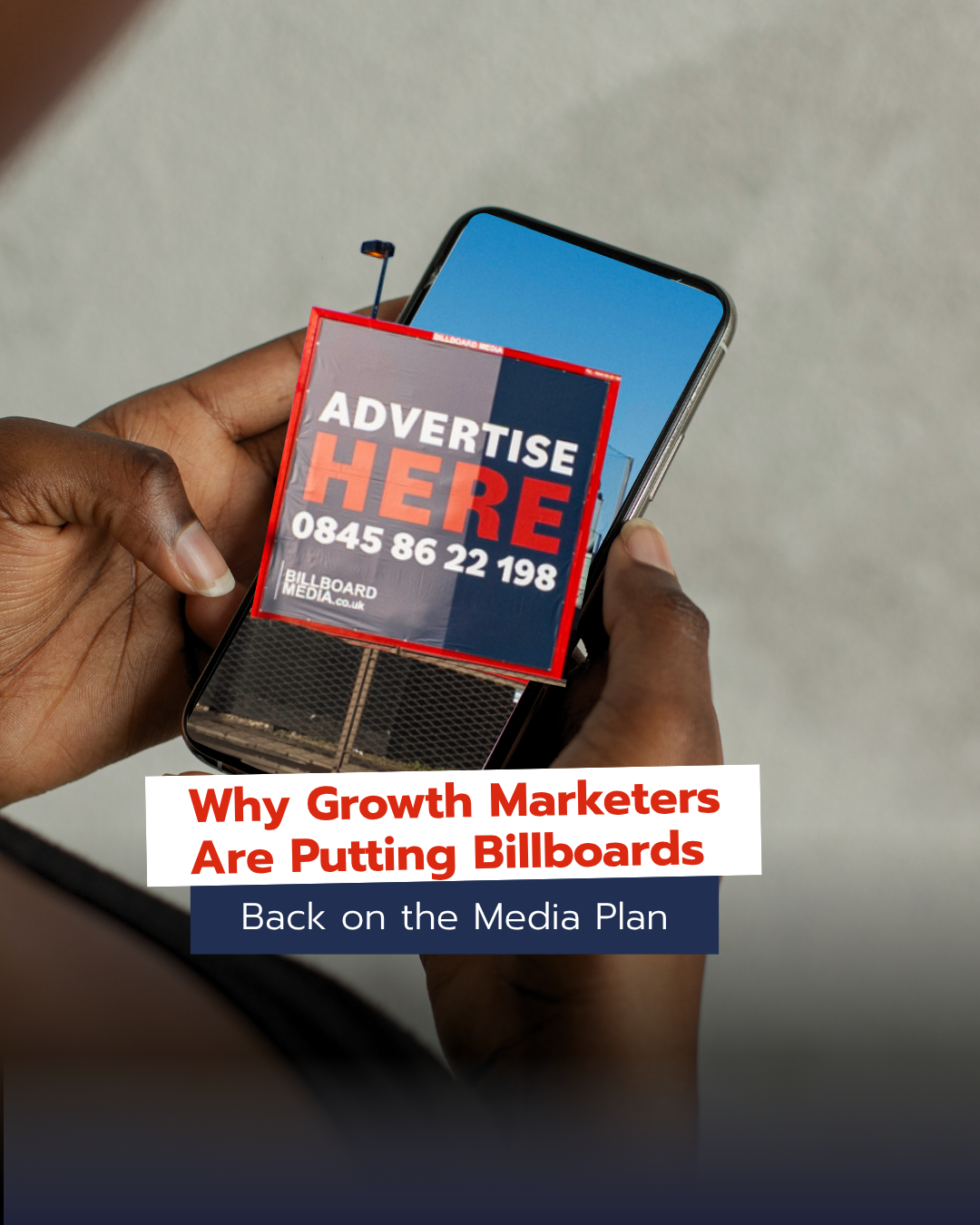
A year ago, if you’d told a performance marketing team to put a budget into a billboard, you’d have been laughed out of the planning meeting. Static. Unmeasurable. No targeting. Why would anyone choose that over a Meta campaign you can optimise in real time?
That conversation is changing, and not because billboards got smarter. It’s because the channels marketers switched to in order to avoid billboards have started behaving a lot more like the problem billboards were supposed to solve: rising costs, shrinking reach per pound, and measurement that’s less reliable than it looks on the dashboard.
Here’s what’s actually changed, and why it’s worth a proper look at out of home advertising again, even if you’ve never booked a board in your life.
Three things have moved against paid social and search in the last 18 months, and none of them are cyclical.
Paid social is getting structurally more expensive, not just seasonally pricier. Meta’s own Q2 2026 filing shows average price per ad up 12% year-on-year, on top of a 12% rise in Q1. That’s not an auction blip, it’s now two consecutive quarters of double-digit inflation, and Meta has confirmed new location-based ad fees of 2–5% landing in the UK, France, Italy, Spain, Austria and Turkey from July 2026. TikTok isn’t the cheap escape hatch it used to be either, CPMs rose roughly 12% year-on-year through 2026, nearly double Meta’s rate of increase, as more advertisers pile into the same auction.
Organic search traffic is being siphoned off before anyone reaches your site. Seer Interactive’s tracking of AI Overview queries shows organic click-through rate collapsing from 1.76% to 0.61%, a 65% fall with zero-click search now sitting around 69% of all queries. Ranking 1 today gets you roughly the traffic that ranking 3 used to deliver. You’re not losing rankings. You’re losing the click, even when you win the ranking.
Meanwhile, out-of-home is growing. Outsmart, the UK OOH trade body, reported Q1 2026 revenues up 15% year-on-year, with classic (static) formats, not just digital screens up 10.1%. That’s not nostalgia. That’s media buyers reallocating budget toward a channel that still delivers guaranteed impressions nobody can block, skip, or scroll past.
None of this means paid social or SEO stops working. It means the “digital is efficient, OOH is a leap of faith” assumption most media plans are still built on is now backwards in several important respects.
This is the real reason billboards got sidelined for a decade, and it’s the part that’s moved the most.
You don’t need a click to prove a billboard worked, you need a plan to capture the actions it triggers elsewhere. In practice that means:
- A unique landing page URL or vanity URL used only on the board, so any traffic to it is directly attributable.
- A dedicated QR code or promo code, giving you a hard conversion number, not an estimate.
- Brand search volume tracking in Search Console or GA4 for the campaign window — a spike in branded search during a live campaign is one of the most reliable signals available, and it’s free to track.
- Route audience data for the specific site, giving you a defensible daily/weekly impressions figure to set against spend for a genuine CPM comparison.
Industry-wide, the effectiveness data backs this up: OOH delivers an estimated £1.60 return for every £1 spent, and IPA research shows 79% of people take some action after seeing an out-of-home ad, 46% search for the brand, 26% go on to visit the website. That’s not a vague brand-awareness argument. That’s a measurable path from board to website that most marketers simply haven’t been told to look for.
The honest caveat: billboards will never give you click-level attribution the way a paid social ad does. What they give you instead is guaranteed delivery, no algorithm deciding whether your audience sees it, no bid war deciding what it costs, no browser or platform update that can quietly cut your reach overnight. In a media environment where two of your three core digital channels just got structurally more expensive or less trackable, “boring but guaranteed” has real strategic value.
But we won’t just give you the stats, here are some of our case studies from businesses we have worked with.
Maxshelf
- Sector: retail/shelving & storage solutions
- Scale: a sustained, multi-site programme, 25 to 30 boards running concurrently, run by an in-house marketing function that treats OOH as a core, always-on channel rather than a one-off test.
- Result: over 10% of new enquiries are tracked back to billboard exposure. For a business running this many concurrent sites, that’s not a lucky campaign, it’s a channel with a repeatable, provable contribution to the funnel, sitting alongside their other marketing activity.
- Why it matters here: this is the clearest rebuttal to “you can’t measure billboards.” Maxshelf treats it as accountable media because they built the tracking discipline to do so.
Skip It
- Sector: waste management
- Mechanic: a dedicated phone number used only on their billboard creative, separate from their main business line.
- Result: the number generates a consistent flow of inbound calls, and Skip It have specifically noted that slow-moving traffic on the road their board sits on gives drivers longer dwell time to read the number and act on it, turning a location most advertisers would see as a drawback into a direct-response advantage.
- Why it matters here: this is the single-tracked-number method in practice, the cheapest, simplest attribution mechanic available, and proof it works even for a traditionally “unsexy” sector.
Sutton Financial Planning Group
- Sector: financial planning/advisory
- Result: existing clients regularly comment on seeing the board in the local area, direct, unprompted feedback that the campaign is reinforcing trust and visibility with people who already know the business, not just reaching cold prospects.
- Why it matters here: for a trust-driven, considered-purchase sector like financial planning, this is exactly the “brand esteem” effect the IPA data above points to — reassurance and local credibility rather than a hard conversion event, and a useful example for any client who’ll ask “but what does it do for a service business, not retail?”
Nobody’s suggesting you replace paid social with static boards. The case is narrower and more useful than that: as a channel to run alongside digital, billboards do two things well that digital increasingly struggles with guaranteed, unblockable reach, and a brand-recall lift that primes people to respond better to your retargeting and search ads. If you’re already running paid social and SEO and watching efficiency erode, adding a static campaign in a well-chosen location is one of the few remaining ways to buy reach that doesn’t get more expensive every quarter.
Looking to drive real footfall and local dominance?
Stay up to date with Billboard Media via our social media channels and subscribe to our newsletter if you want to be updated with information about available billboards in your area.
Get on our priority list for a location you’re interested in by sending us a WhatsApp message.